GarageVac by InterVac — Clean made Simple
A finished two-car garage with an epoxy floor and a wall of vintage motor-oil signs. A GarageVac is mounted on the right-hand wall, its hose stretched across to a Mercedes with the driver's door open.

GarageVac by InterVac® · Clean made Simple® · Molded & assembled in Palm City, Florida

A jobsite vacuum doesn't belong in a garage like yours.

A GarageVac GH120 in ebony mounted on a garage wall, hose wrapped around the body and the cleaning tools stored in the caddy at the top.
This is it. GH120 in ebony — 29½″ tall, only 4″ deep, 9 lbs.

GarageVac lives on the wall. Nine pounds, thirty-five feet of reach, and nothing hard rolling around next to your paint. Mount it in ten minutes and get your floor back for good.

From $279 Free shipping Ships in 1–2 business days

Checkout is handled securely by InterVac Design Corp — the company that builds GarageVac.

  • 2-year warranty
  • UL certified
  • 514 air watts
  • Free shipping over $199
  • Body molded in Palm City, FL
0sq ft of floor space

The whole point

Every other vacuum in your garage is also furniture. This one is on the wall at eye level, out of the walking lane, out of the parking envelope, and out of reach of anything you'd rather not scratch.
Two and a half feet of wall · 35 feet of hose · 9 lbs

The honest comparison

So why not just use the drum vac?

Because a rolling wet/dry drum is a jobsite tool that happens to live in your garage. It is bulky, it is top-heavy on four small casters, and garage floors slope toward the door. So it gets dragged around, it parks where you'd rather walk, and it spends its life at rocker-panel height next to a fender you had painted twice.

  GarageVac Wet/dry drum vac Built-in central vac
Floor spaceNone — it's on the wall2–4 sq ft, permanentlyNone, but the canister lives somewhere
Reach35 ft of hose from one pointHose plus a cord you keep re-pluggingWhole house, if you ran the pipe
Setup, every timePull the hose off the wallRoll it out, find an outlet, unwindCarry the hose to the nearest inlet
What you handleA soft hose. The 9 lb unit never moves.A bulky 20–30 lb drum you tow behind youA long hose to carry and store
Near your paintNothing rigid ever reaches the floorA hard shell on casters, right at rocker and door-edge heightNothing rigid on the floor
Can it tip?No — it is screwed to the wallTop-heavy on a narrow base, on a floor that slopes to the doorNo — the canister is fixed
Where it lives2½ ft of wall, above the bumper lineWherever it was last pushedA closet, the attic or the garage corner
FiltrationHEPA-type, rated to 0.3 micronOften recirculates the fine dustVaries; usually vented outside
InstallationFour screws. Ten minutes or less.NoneContractor, wall work, days
In a finished garageLooks like it belongs thereLooks like the jobsite it came fromInvisible — that's the appeal

Scroll the table sideways →

Two models

Pick your setup

Black or White A white GarageVac GH120 mounted on a wall, tools stored in the top caddy and the stretch hose connected at the inlet.

GarageVac GH120

SKU 8-GH-120-X

The original wall-mount. Everything needed to keep a two-car bay and both interiors clean, on four screws and a standard outlet.

  • 514 air watts, 110″ water lift
  • 35 ft stretch hose, shrinks to 8 ft
  • Seven tools stored in the built-in caddy
  • 29½″ H × 9½″ W × 4″ D · 9 lbs

$279Free shipping

Remote control A GarageVac in ebony mounted on a garage wall, hose wrapped around the body and tools stored in the caddy at the top.

GarageVac GH120-E-RC

SKU 8-GH-120-X-REMOTE · Ebony or White

The same vacuum with the switch moved into your hand. Kill the suction from inside the car instead of walking back to the wall every time you reposition.

  • On/off in the pistol grip, 100 ft range
  • 35 ft stretch hose, shrinks to 8 ft
  • 29½″ H × 9.2″ W × 4″ D · 9 lbs
  • Ships with a high-filtration bag fitted

$361.08Free shipping

Ebony White

Buy in Ebony →

White is built to order. Email orders@intervacdesign.com and we will confirm lead time and take the order.

The numbers

What you're actually buying

514AWAir watts
110inWater lift
35ftHose reach
9lbOn the wall
0.3µmFiltration
10minTo install

Why we say 35 feet

It stretches closer to forty. We publish the conservative number on purpose — if you take a tape measure to it, we would rather you find more hose than we promised than come up two inches short. That is the same reason every other number on this page is the one we can prove.

120V · 10.7A · 50/60 Hz · 5½ ft attached cord · 1 gallon / 7 lb debris capacity · hypoallergenic triple filtration · polycarbonate and ABS body · UL certified · 2-year warranty. Handles dust, sawdust, dirt, metal shavings and small hardware.

Like for like

The specs nobody else publishes

Wall-mounted vacuums tend to advertise whichever number sounds biggest — peak horsepower, or the wattage the motor draws. Neither describes what reaches the end of the hose. Here is every figure we publish, beside the same figures from the three closest competitors, taken from their own product pages.

Specification GarageVac GH120 Giraffe Tools Grandstorm Bissell Garage Pro 18P03 Prolux Wall Mounted
Sealed suction How hard it pulls. Ours in inches of water lift; converted, 27.4 kPa. 110″ water lift (27.4 kPa) 20 kPaNot publishedNot published
Air watts Suction and airflow together — the only figure describing work actually delivered. 514 AW Not publishedNot publishedNot published
Filtration, to a stated micron "HEPA" without a micron figure is a word, not a measurement. HEPA-type, rated to 0.3 micron "HEPA" — no micron published "2-stage" — no micron published "Standard HEPA" — no micron published
How the dust is contained The part you actually have to deal with. Sealed disposable bag, about 4 months per bag Bagless bin, 4.5 gallonBagless tank, 4 gallonReusable cloth bag, 22 L
What emptying it is like See the note below. Pull the sealed bag out, drop it in the trash. Nothing goes airborne. Carry a loaded bin to the trash and tip it out Carry a loaded tank to the trash and tip it out Shake the cloth bag out and refit it
How far it sticks out from the wall What you squeeze past with a car door open. 4″19″ Not publishedNot published
Unit weight What is hanging on your drywall. 9 lb42 lb25 lb25 lb
Hose 35 ft stretch, from 8 ft30 ft retractable32 ft30 ft
Where the body is molded Not who ships it — who makes it. Palm City, Florida Not publishedNot published "Designed and developed in USA" — manufacture not stated
Warranty 2 years2 years Not published3 years
Price $279$297–$351$249.99$299.99

Scroll the table sideways →

Why we still use a bag

Bagless looks like the convenience feature until the day you empty one. You carry a loaded bin across the garage and tip it into a trash can, and the fine dust you just spent an hour collecting — brake dust, drywall, pollen, whatever came off the mats — comes straight back out at face height. A reusable cloth bag is the same problem with extra steps. Drop either one and it is in the air of a closed garage you are standing in.

A sealed bag goes from the vacuum to the trash without ever being opened. You handle it about three times a year and you never breathe what was in it. That is the entire argument, and it is why we did not go bagless when it would have been cheaper to.

Why watts and horsepower don't tell you anything

Watts describe electricity going in. Peak horsepower describes a motor spun up unloaded on a bench — no hose, no filter, no bag — a number no vacuum ever produces in a garage. Air watts describe suction and airflow together at the end of the hose, which is the only place it matters to you. It is the harder figure to publish, which is why fewer companies do.

InterVac has written this up at length: why horsepower ratings are misleading and why horsepower isn't relevant to vacuums.

Competitor figures taken from each manufacturer's own published specifications, recorded 31 August 2026: Giraffe Tools Grandstorm retractable wall-mounted vacuum; Bissell Garage Pro 18P03; Prolux wall-mounted wet/dry garage vac. "Not published" means the figure was not stated on that product page on that date. Water lift converted at 1″ H2O = 249.09 Pa. Specifications, prices and product lines change — check the manufacturer before relying on any of it.

The missing number

Why nobody else prints an air-watt figure

Air watts is not a proprietary measurement. There is no license to buy, no trade secret, no lab you have to be invited into. Any manufacturer can put a vacuum on a test rig and publish the result, and it costs them a morning.

So when a company leads with 1,200 watts, or 6.5 peak horsepower, or a kPa figure — and then says nothing at all about air watts — that silence is a choice, not an oversight.

Look at what those other numbers actually describe. Watts is the electricity the motor pulls out of your wall — a cost, not a result. Peak horsepower is a motor spun up on a bench with no hose, no filter and no bag on it, at a load no vacuum ever runs at. Sealed suction is how hard it pulls with the end of the hose blocked, which is not how anyone has ever vacuumed anything.

Every one of those can be raised by bolting a bigger motor to a restrictive air path. Air watts cannot. It measures suction and airflow together, at the end of the hose, with the filter and bag in place — the machine actually doing its job. It is the one figure a bigger motor alone will not fix.

We publish 514. Ask the others for theirs.

And if any of them do publish one, send it to us — we will put it straight into the table above. It is there to be updated, not to be won.

Read the buyer's guide →

Nothing to add

It arrives complete.

No starter kit, no "tools sold separately." Every attachment stores in the caddy built into the unit and the hose wraps around the body, so the whole system lives in two and a half feet of wall.

The housing itself is injection-molded at InterVac's own plant in Palm City, Florida — the tooling is theirs, and every replacement part ships from the same building that made the unit.

  • 35 ft stretch hose with pistol grip
  • Telescoping wand and holder clip
  • Bare floor tool — rollers and horsehair
  • Snake wand for console gaps
  • Crevice tool
  • Elongated dashboard brush
  • Two-part upholstery brush
  • Mounting hardware and a paper template
A GarageVac mounted on a garage wall with the hose run to the open driver's door of a white sedan being vacuumed.

Installation

Ten minutes, four screws, one outlet.

No electrician, no wall opening, no pipe run. If you can hang a shelf, you can hang this.

01

Mark the wall

Tape up the printed guide anywhere with 2½ feet of vertical space and an outlet within 5½ feet. Center it in the bay and the hose covers both cars.

02

Drive four screws

Into studs or anchors, straight through the guide. The unit is 9 lbs, so you are not wrestling it into position.

03

Hang it and plug in

A standard 120V household outlet. Load the tools into the caddy, wrap the hose, and you're cleaning.

Want it flush? The GH120 can also be recessed into a standard 2×4 stud wall instead of surface-mounted — so it sits flat with the drywall and reads as part of the build, not as equipment hung on it.

Keeping it running

Bags and filters

A bag runs about four months in typical garage use, so a five-pack is close to two years of cleaning. Genuine bags are what the filtration rating is measured with — and non-genuine consumables void the vacuum warranty, which is a bad trade for a couple of dollars.

Y08-5

Dust bags, five-pack
with motor filter

  • Five HEPA-type dust bags
  • One motor filter, to protect the motor
  • Fits every GarageVac, plus H, F, LH, GF, RMH and RMF units
  • About four months per bag in normal use

$20.75 $18.87Five-pack

Buy a five-pack →
Never think about it

Bags Essentials

Genuine bag
delivery subscription

  • Genuine five-packs with motor filter, shipped to you
  • One, two or three shipments a year — your call
  • Free standard shipping in the continental US
  • 10% off one-time accessory orders
  • Pause, change or cancel from your account any time

From $20per year

Choose a plan →

Everything about bags on one page →  ·  Bags for other InterVac models — Y20-3, Y11-5, Y10-5 and Y09-5 — are available on the InterVac store. The subscription covers any of them.

In the wild

Where it ends up

The InterVac show vehicle, a white Jeep Wrangler Rubicon in GarageVac livery with red underglow, displayed on polished concrete at a trade show alongside a GarageVac demo stand.
On the road — the InterVac show rig, where most of these get sold in person.
A white GarageVac mounted low on a garage wall beneath a collection of vintage Texaco, Shell and Sinclair motor-oil signs.
Under the sign collection, where a rolling drum vac would ruin the shot.
Someone vacuuming the carpeted trunk of a white sedan using the GarageVac hose run from the wall unit behind them.
Trunk, footwells, mats — all from one mount point.
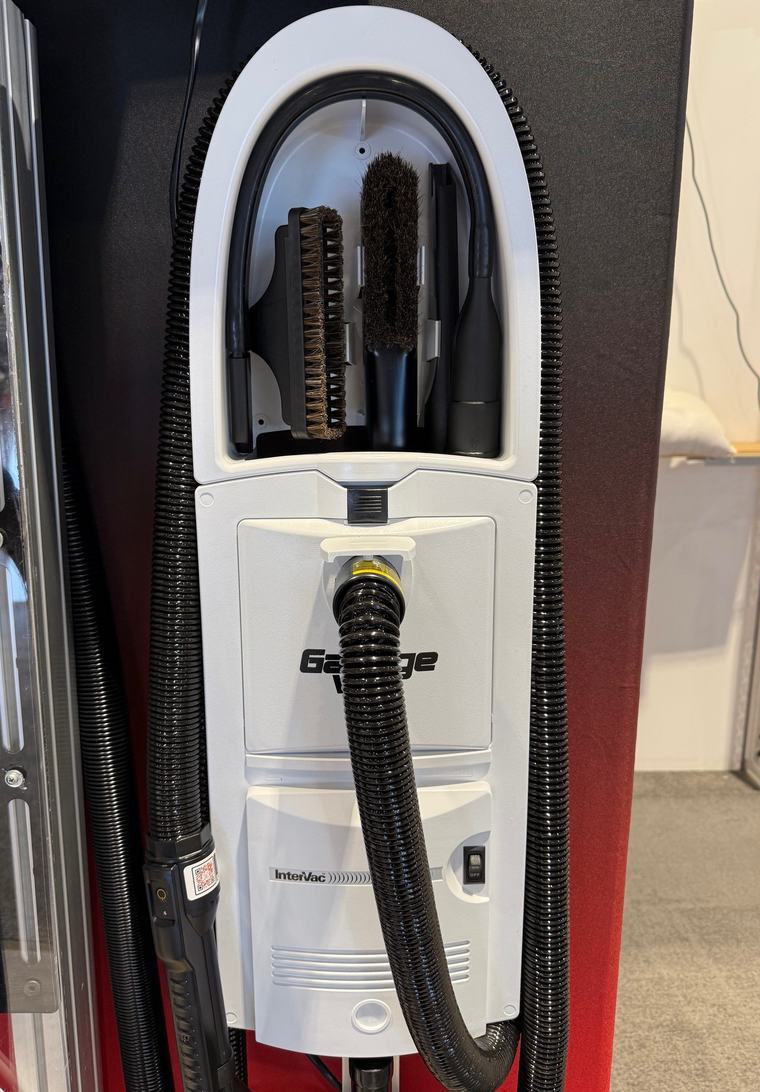
Close view of a white GarageVac showing the tool caddy with brushes stored in the top, the hose inlet and the InterVac badge.
Tools stored in the unit. No bin of loose attachments.

Straight answers

Questions people actually ask

Will 35 feet really reach my whole garage?

In a standard two-car garage, yes — mount it centrally on the back or side wall and the hose reaches both vehicles, all four footwells, the trunk and the floor between them. It sits compressed at about 8 feet and stretches out to 35, so you are never managing slack you don't need.

In practice it goes a little further than that. We publish 35 feet because it is the number we will always beat, not the number we hope you never check. In a three-car or deep bay, mount toward the middle rather than a corner.

Can it damage my paint?

The only thing that moves around your car is a soft hose and the tool on the end of it. The vacuum itself never leaves the wall.

That matters more than it sounds. A drum vac is bulky and top-heavy on a narrow set of casters, garage floors are poured with a slope toward the door, and the whole thing sits at exactly rocker-panel and door-edge height. Give it a tug on the hose and it rolls; catch it wrong and it goes over. A wall-mounted unit removes that failure mode completely — there is nothing on the floor to roll, tip or be backed into. For a lot of our customers that is the entire reason they bought it.

Bagged or bagless?

Bagged, and deliberately so. Triple HEPA-type filtration rated to 0.3 microns means the fine dust ends up sealed in the bag instead of back in the air of a closed garage.

Bagless bins are marketed as the convenience option, but you still have to empty them — carrying a loaded tank to the trash and tipping it out puts the brake dust, pollen and allergens you just collected straight back into the air you are standing in, and dropping one is worse. A sealed bag goes from the vacuum to the trash without opening. The bag holds about a gallon and runs roughly four months in typical use, so you deal with it three times a year.

Use genuine InterVac bags and filters — non-genuine consumables void the vacuum warranty. A five-pack with motor filter is $18.87, or you can put them on a delivery subscription and stop thinking about it.

Do I need an electrician or any wall work?

No. It mounts with four screws and plugs into a standard 120V household outlet on a 5½-foot attached cord. Nothing goes inside the wall — that's the difference between this and a built-in central vacuum. If you do want the flush look, it can be recessed into a 2×4 stud wall, but that's optional.

What's the warranty, and who honors it?

Two years, honored directly by InterVac Design Corp — the manufacturer. They build the unit in Palm City, Florida and stock every replacement part, so the warranty and the parts come from the same place. Units bought through resellers are covered under that reseller's own terms.

Why does checkout happen on intervacdesign.com?

Because it's the same company. GarageVac is built by InterVac Design Corp, and intervacdesign.com is their secure store — the one that holds your order, your warranty registration and your parts history. You're buying factory-direct, not through a marketplace.

How fast does it ship?

Orders leave Palm City, Florida in 1–2 business days and typically arrive within 2–7 days. Shipping is free on orders over $199 in the continental US, which covers both models.

Where is it actually made?

The polycarbonate/ABS housing is injection-molded at InterVac's own plant in Palm City, Florida, and the units are assembled there. Some components — motors and certain small parts — are sourced globally, which is true of essentially every vacuum sold in the US. What that means practically: the tooling, the molds and the people who build it are here, replacement parts ship from the same building, and warranty work does not go overseas.

Will it work outside a garage?

Yes. The same unit goes into workshops, RVs, boats, cabins and utility rooms — anywhere you want real suction without storing a canister. It only needs 2½ feet of wall and an outlet.

The rest of the range

GarageVac is one of several.

InterVac builds wall-mounted vacuum systems for RVs and motorhomes, boats, salons and barbershops, workshops, pet grooming rooms and whole homes — plus every bag, filter, hose and tool for all of them. If you need something this site does not cover, it is on the main store.

InterVac — Clean made Simple Visit intervacdesign.com →

Same company. Same warranty. Same building in Palm City.

Get it off the floor.

Free shipping, out the door in 1–2 business days, two-year warranty direct from the people who build it.

Choose your GarageVac →